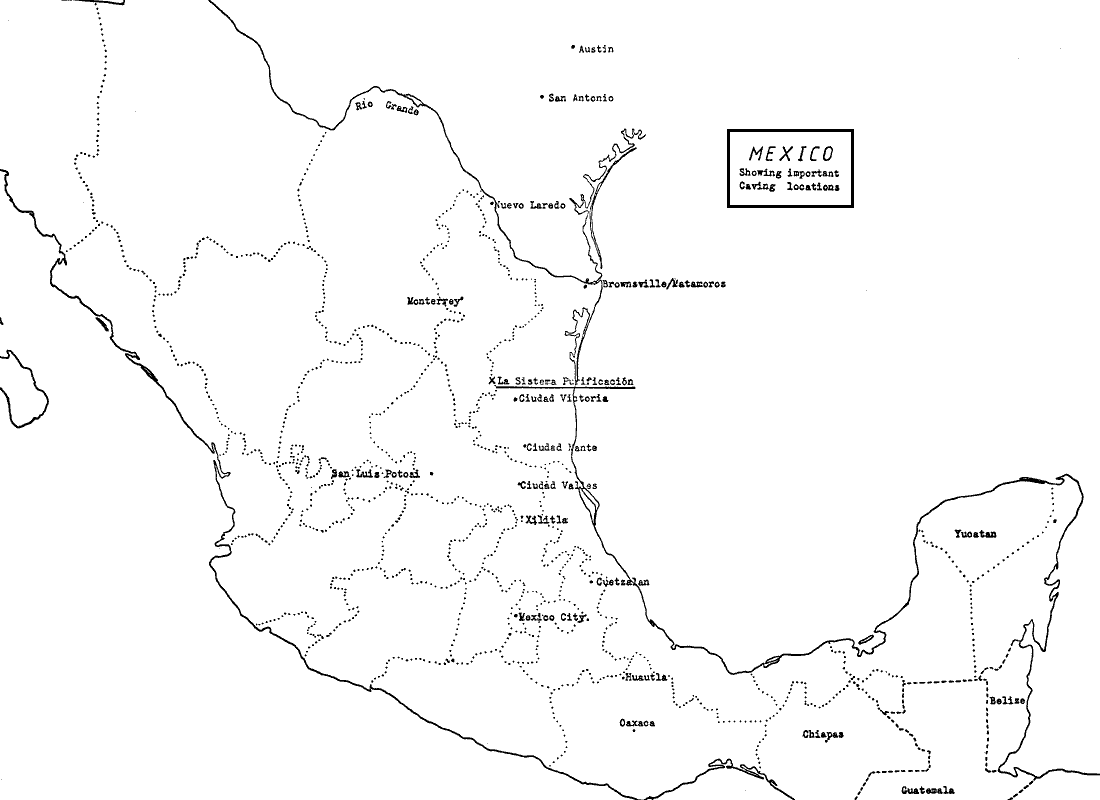
Readers of the caving press, especially Caving International, will no doubt be aware that great things are being discovered in Mexico, but are probably less aware of the great variety of the areas being explored. The following introduction is intended to place the Mexican discoveries in context as a background to the spring project in which I participated.
Cave exploration has been going on for many years, in the main by US cavers, which led to the formation of an informal group called the Association for Mexican Cave Studies (AMCS) whose rôle now is to collect and publish information on the caves of Mexico and to co-ordinate trips to avoid duplication of effort. It is recommended that any group planning to travel to Mexico should be in contact with the group, based in Austin, Texas.
As cavers explored into the karst of Mexico, it was natural that those regions nearest the main roads should be the first to come under scrutiny, and the earliest AMCS Bulletin "Caves of the Inter-American Highway" reflects this. A series of limestone mountain ranges along the El Abra reef trend - the Sierra Madre Oriental - were explored, the most promising of which were the Sierra de Guatemala south of Ciudad Victoria, the El Abra south of Ciudad Mante and the Xilitla Plateau. The latter area contained the deep pits of Sotano de las Golandrinas and El Sotano - the largest free drop pit in the world.
Further south, the spectacular karst plateau of Huautla de Jimenez was discovered, leading to the exploration of the deepest caves in the Western hemisphere - Sotano del Rio Iglesia and Sotano de San Agustin. Trouble with the native population led to a self-imposed moratorium on exploration in the area for ten years. South West of Mexico City, a large area in Guerrero and Morelos contains such famous caves as Grutas de Cacahuamilpa.
More recent explorations have penetrated further from the main highways both in the north and the south, and further exploration has continued in the other areas. To the east of Mexico City, the Cuetzalan area has yielded long river caves with huge passages, several streams converging to give Mexico's second longest system. Much further south, exploration in Chiapas, mainly by Canadians (including many expatriate Brits) has been rewarded by such finds as Sumidero Yo Chib, at the time of its exploration probably the most spectacularly and dangerously wet cave in the world. In Huautla, the renewed exploration has found a series of deep caves, all close to connecting into one huge system. The first of the connections came when the very deep Li Nita was connected by diving to Sotano de San Agustin to yield a system 1220m deep. This area was also the scene of a very serious rescue when a Polish caver broke his back deep inside San Agustin. Further south still, expeditions have penetrated into Guatemala and Belize.
In the north of the country, the northern end of the Sierra Madre Oriental was penetrated by long dirt roads, and when exploration of the area started, the rewards were considerable, leading to the discovery of the caves which were eventually to form La Sistema Puricación, which is still being explored by an AMCS under the direction of Peter Sprouse and Terri Treacy.
The cave is located in Ejido Conrado Castillo in the mountains north west of Ciudad Victoria, and was known to the local populace long before the arrival of the American Cavers. The Historic Section of Cueva del Brinco shows signs of a considerable history of investigation, so when members of the AMCS first arrived in the area in the early seventies, they were quickly directed to the entrance and the potential of the area was realised. On subsequent visits, they were shown a large, inaccessible cave entrance in a cañon headwall about three miles away and 850m lower. When the entrance was reached, the huge passages of Cueva de Infiernillo were seen for the first time and the dream of a connection was established.
At the start of the spring trip of 1978, Cueva del Brinco had been surveyed to 6.5 km long and 257m deep, while Infiernillo was 4.6 km long. A third strongly draughting cave, Sumidero de Oyamel, had also been found the previous autumn. During the Spring Project, a huge trunk passage with a stream, The World Beyond, was found in Brinco which was heading away from Infiernillo, but after a mile or so, it abruptly turned about and dropped steeply. After the spring trip, Brinco was 9.2 km long and 382m deep, already a significant cave. Oyamel was just over 1km and 125m deep.
Exploration fever set in, with a return to Infiernillo in July (nominally the wet season) in which the cave was surveyed to 9km, and passages were explored which had to be very close to Brinco. In again from the Brinco end, and flagging tape was found which could only have been placed by the Infiernillo crew - on July 13th, the connection was surveyed and Sistema Purificación was born: 20.086 km long and 884m deep, the longest and deepest cave in Mexico.
A trip in December saw the system's first accident, when a caver fell and broke his leg in the recentlky discovered Valhalla section of the cave, but a remarkably smooth rescue organised from the USA saw the injured man safe after three days in the cave. The spring project of 1979 saw more surveying in the phreatic mazes of the Confusion Tubes area in Infiernillo and the discovery of Moria, an important lead toward a postulated Great Western System. It also saw a 20 hour through trip with Claude Chabert and Paul Courbon, who then dug out a new top entrance to the Valhalla region - the Entrada de los Franceses. At the end of the spring, the cave was almost 28km long.
Useful infomation was gathered on the system in flood when 19cm of rain fell in a storm in December, when the sumps at the bottom of the system were seen to be 64m above their dry season level. In spring 1980, attention was returned to Oyamel, which was surveyed to 2.5km and then connected in to the upstream end of the World Beyond. At the end of 1980, the system stood at 38km long and 895m deep - by far the longest, but no longer the deepest in Mexico.
 NPC Large Pot Journal 1982:
 Next page: Mexico 1981: Spring Project
Back to contents
Previous page: When you gotta go, you gotta go !
Out of print publications list
Northern Pennine Club Home page
Next page: Mexico 1981: Spring Project
Back to contents
Previous page: When you gotta go, you gotta go !
Out of print publications list
Northern Pennine Club Home page