NPC Journal 4(1), Jan 1987, pp 61-65
TECHNIQUES AND EQUIPMENT
Caving Accidents
Management from site to surface. for those in the unfortunate
party or attending as rescuers - general guidelines
Dr. D. Gibson, MB, ChB(Leeds), DA(UK)
It appears from reading the recent CRO figures that fatal caving
accidents are predominantly from drowning and long falls. The
treatment of a very seriously injured person, or victim apparently
drowned has an understandably poor chance of a successful outcome and
so the prevention of these accidents is of prime importance. This can
be achieved through the thorough checking of equipment prior to use,
suitable training in the use of potentially dangerous techniques and
sensible choice of cave in poor weather.
There are, however, many less serious injuries that may befall the
unfortunate speleologist and it is for these that I wish to provide
guidelines for expedient and safe evacuation, whether in the Dales or
Darkest Jungle. Readers should note that some degree of medical
experience is assumed, since injuries must be properly diagnosed
before they can be treated. For basic background reading on the
subject I have mentioned some useful books at the end of the
article.
Lower Limb Injuries
These are frequent accompaniments of falls. If fractures are evident,
the predominant deciding factors in mode of evacuation are the site
of the accident and whether or not the fracture is compound (ie.
associated with a surface wound).
Ankle
A severely sprained ankle can be as painful as a broken one. It will
exhibit loss of stability and tenderness over bony prominences. The
salient points are :
1) leave the boot on;
2) bathe in cold water to reduce swelling;
3) if possible, evacuate under the victim's own steam, often without a call-out.
Negotiation of pitches is the difficult part with these injuries, but
a good lifeline does a lot to help. SRT is possible too.
Lower leg
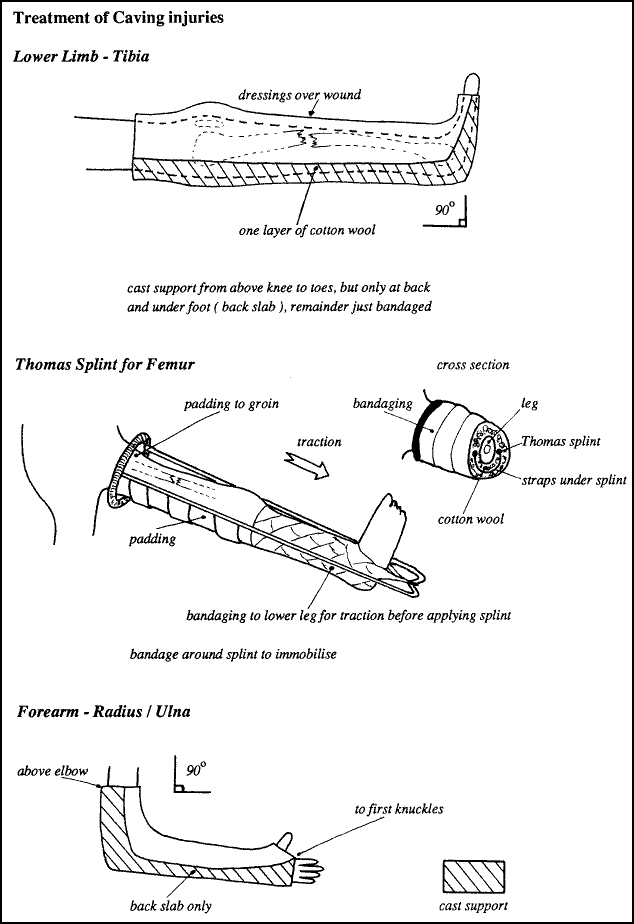
Fractures to the tibia and fibula leave an unstable foot causing
great pain on movement. Splinting the leg, either to the other leg or
to a piece of wood, does a lot to alleviate pain on moving. A
casualty may be evacuated in this way if the cave terrain allows it,
but if a long or difficult series of passages in anticipated, a
suitable (eg. Baycast-type plastic) support should be used. This
requires some degree of skill and inevitably a call-out. If the
fracture is compound (remember the tibia is just under the skin)
dressings should be applied to the wound and antibiotics given.
Knee
A severely sprained knee will swell sufficiently to prevent much
useful movement. It may need splinting and careful evacuation,
although not always on a stretcher. A fractured or dislocated kneecap
is similar. The latter may be involved with a laceration and should
be suitably dressed with an antibiotic cover.
Upper Leg
A fractured femur is the result of a quite severe fall and one should
seek evidence of other injuries, particularly of the spine, before
moving the casualty. Again it is possible to splint the two legs
together in order to evacuate the victim. The patient will be unable
to stand or crawl very far due to the pain. The bones invariably
overlap owing to the pull of the overlying muscles. The most
appropriate means of reasonable stabilization is with a Thomas
splint, particularly if much passage or many pitches are to be
involved. A stretcher is therefore almost mandatory. Blood loss into
the fracture site can be up to four pints or more, so the patient
will often be shocked with a thready pulse, and be restless. A
compound fractured femur may bleed very severely and firm dressings
will thus be needed. The risk to life from this type of fracture may
indeed be quite high and monitoring the welfare of the casualty
throughout the evacuation is important. Consideration should be
given to an intravenous infusion (drip), though this has not to my
knowledge been resorted to in any CRO rescues so far.
Pelvis
These are often stable fractures by the nature of the anatomy and
careful movement of the injured can allow self-evacuation. If very
painful, a stretcher may be necessary. Passing blood instead of urine
suggests rupture of the plumbing and nothing can be done before
hospitalization. Again, spinal injury should be sought before risking
movement of the patient.
Chest
Fractured ribs are painful. But again, the anatomy means that they
are fairly stable fractures. The odd fracture without complications
can often be helped out without a stretcher. The danger lies in
possible puncture of the lungs producing a pneumothorax with
difficulty in breathing. Again, careful movement out should avoid
this complication but it may already have occurred at the time of the
accident, particularly if there are compound fractures. Covering a
wound helps, but occasionally a doctor may have to consider
introducing a large needle into the chest wall. This is potentially
dangerous and only in extreme cases should it be considered.
Abdomen
Any fall, whether causing multiple limb injuries, or perhaps only
minor scratches, can cause rupture of internal organs. This is
particularly likely if the fall was onto the side or front. Fractured
ribs may give clues to this. A badly torn spleen can cause
exsanguination in under an hour, but such injuries are the exception.
Rapid evacuation to a hospital is of prime importance if abdominal
injury is suspected. Abdominal pain and a shocked patient are warning
signs. Again, an intravenous infusion, even if only set up on arrival
at the surface, may be life saving. The use of a helicopter may be
necessary with remote entrances to speed travel to a hospital. The
use of strong painkillers (eg. morphine) can mask the signs of
intra-abdominal trauma and thus care in the use of these agents is
important.
Upper Limb Injuries
Hand and Fingers
Sprains or fractures should not usually require a call-out unless
many pitches have to be negotiated. Fingers should be strapped to
neighbouring fingers for splinting. Broken bones in the hand can be
supported, prior to being bandaged, by a rolled pad in the palm.
Wrist
The fracture may be supported with a triangular bandage or a splint
arranged to stabilize it. The caver may then often be able to go out
under his own steam. Sprained wrists frequently benefit from
strapping with firm bandaging.
Forearm
Breaks of the radius and ulna bones may frequently be compound. These
require sterile dressings over the wound followed by splinting. If
severely unstable, a plaster of Paris pot may have to be applied
where long lengths of passage are to be negotiated. Given these
precautions though, the caver may often exit with minimal help.
Elbow
Broken bones close to the elbow are often pulled out of alignment by
their muscle attachments. One has to be careful that the pulse is
palpable at the wrist in the position at which the elbow is splinted
(usually at 90°). Support by a triangular bandage is
useful.
Upper Arm
Breaks to the humerus less frequently result in a compound fracture.
They may often be managed by the hand being supported by a sling
around the wrist and neck (collar and cuff). The weight of the arm
reduces the bones to a good position. As usual, the patient will have
most difficulty in ascending pitches, and in long crawls or tight
constrictions.
Shoulder
Dislocation of the shoulder in some folk is a frequent and
distressing occurrence. When recurrent, this may occur at the
slightest provocation. If the pain is not extreme, with much muscle
spasm, an experienced person may be able to relocate the shoulder,
especially if the patient has experience of the process. However,
in many cases it is better to immobilise the arm by strapping it
to the chest. There have been incidents where the injury has been
worsened by over-enthusiastic attempts at relocation while still
underground.
Collar bone
This is the most commonly broken bone, occurring when falling onto an
outstretched arm. The loss of stability of the arm can make crawling
and pitches difficult, but over a short distance, self-evacuation is
frequently possible. Supporting the arm with slings helps, as does a
figure-of-eight arrangement over the back pulling the shoulders
backwards.
Back
The possibility of back injuries can be inferred from the position of the
caver; for example, if he has landed on his back on boulders; or by major
fractures, for example of the femur. If conscious, he should be asked if he
can move his legs or if he has any pain in the back. A patient with a
suspected spinal injury shouldnot be moved until plenty of assistance is
available. If a stretcher is to be used, he should then be carefully secured
to it, lifted by at least four people. If difficult cave is to be traversed,
the use of a spinal splint, fitted by an expert with the rescue team, is
often better, since it allows the injured caver to help himself.
Feeling down the curve of the vertebral column for loss of continuity or
tenderness is useful as an indicator of possible problems. Fractures may be
of the bony prominences of the vertebrae, when the risk of spinal cord
damage is low. However, this is difficult to be sure of underground and care
should be taken in any case. Loss of movement may only be temporary (spinal
shock): further damage must be avoided at all costs. In the event of a
potential spinal injury beyond difficult or tight crawls, the risk of
further damage is very high. If neck injuries are suspected, a cervical
collar may be used, and one person holds the head steady whilst this is
fitted.
Head Injuries
This broad category ranges from a few minutes unconsciousness
following a bang on the head, to severe compound skull fractures with
deep coma or semi-consciousness. No-one can save brain damage already done
but further complications should be minimised. Open fractures and
wounds must be covered. If talking, the patient should be talked to,
ensuring that he doesn't become unconscious unbeknown to the
rescuers. If unconscious, the airway is liable to become blocked by
the tongue falling into the back of the throat. Insertion of an
airway prevents this, as does the adoption of the recovery position,
with the face downwards. If breathing stops, the airway should be
checked and artificial respiration commenced, once every five
seconds. Remember to pinch the nose and extend the head backwards,
looking for chest movement. If no pulse is present, external cardiac
massage can be begun compressing the lower breastbone firmly with the
heel of the hand once a second. No further treatment of head injuries
may usefully be offered underground except observation and care of
the airway. If much blood is coming from the mouth, evacuation of the
casualty face-down is desirable, although the standard Neil-Robertson
stretcher is poorly designed for this.
Hypothermia
This ever-present danger may occur as the single problem in a tired
individual or in addition to other injuries, in themselves not fatal.
Waiting for a rescue team can allow a fall of body temperature to begin. If
the temperature drops sufficiently (ie. to less than 30°C) the heart
contracts incoordinately, and death ensues. Wet, windy areas in a cave, such
as near pitches, are the most dangerous. If an injured caver cannot make his
own way out until help arrives, consideration should be given as to whether
a different position will reduce the tendency to lose heat. If spinal injury
is suspected, then the relative risks of exposure and further damage must be
assessed.
The warmth of companions huddled together, sitting on tackle bags, or the
use of 'space' blankets are all useful. When available, a neoprene casualty
bag should be used at the first opportunity, possibly with heated inspired
air or oxygen. If dry clothing is available, it is well worth while removing
wet garments and replacing them with dry, providing they can be kept dry
afterwards. One should keep an eye on the rest of the team to ensure that
hypothermia is not creeping up on them, impairing judgement in difficult
circumstances.
On reaching the surface, the patient should again be as well
insulated as possible and allowed to warm up slowly by his own
body heat. The use of a hot bath is very controversial and should
never be attempted without medical supervision. The sudden
rush of blood through cold outer tissues may lead to further
cooling of the core, with potentially fatal results.
It can be very difficult to decide if a very cold patient is still
alive, as pallor; fixed, dilated (large) pupils; apparently absent
pulse; and very shallow breathing may be found in people still alive.
If in any doubt, one should continue to treat the patient as alive
until someone experienced can declare that he has expired.
Death
To decide if this has supervened, either soon after the accident or
during evacuation, can be difficult. The nature and severity of the
injuries can give clues, but as stated above, if cold is an important
part of the patient's condition it can be very hard to determine. If
in doubt, the advice of a doctor must be sought. Absence of pulse
and breathing, and fixed, dilated pupils are the classic features to
be found.
Drownings
One should persist with artificial respiration and external cardiac
massage for at least 45 minutes, although if the caver was underwater
for long enough, no-one can revive him. However, success has been
achieved and one must always try.
Acid or Alkali Burns
These should be washed liberally with water and dressed with gauze if
possible.
Medical Problems
Heart attacks, appendicitis, diabetic comas and so on can all occur
whilst caving. It is beyond the scope of this article to mention
everything, but general supportive measures should be taken and
evacuation out of the cave begun at the earliest opportunity.
Useful reading :
St. John Ambulance First Aid Manual
Several books on first aid for Hillwalkers or Mountaineers are
available and the principles apply equally to the caving situation.
Medicine for Mountaineering - Wilkerson. A comprehensive guide for
doctors and lay persons alike.
Following are a number of helpful illustrations
and a guide to equipment that may be carried. It is
not intended to be exhaustive and additions or omissions can be made
depending on the situations to be faced.
Happy Caving !
 NPC Journal 1987:
 Next page: Appendix: First Aid equipment
Back to contents
Previous page: Mulu by Petzl light
Out of print publications list
Northern Pennine Club Home page