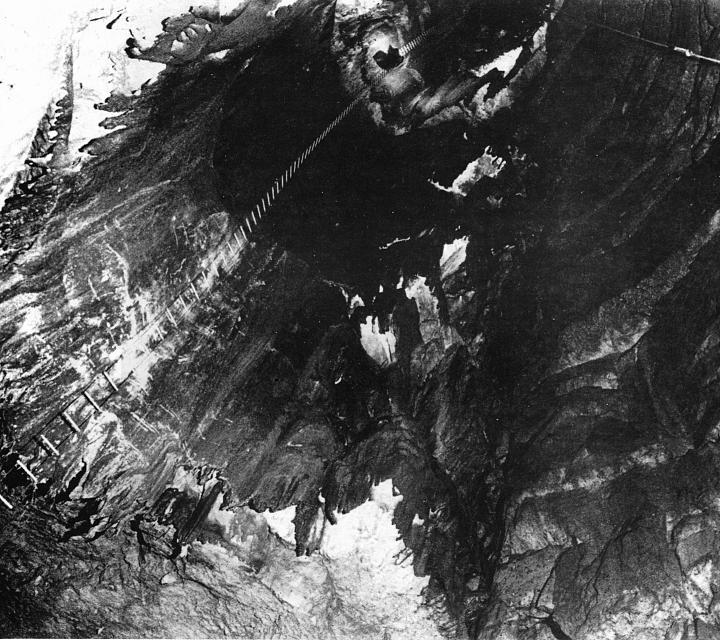
Large Pot has two distinct series that diverge 120 ft. below the rather awkward entrance, the total length of passages surveyed being 3,874 ft. First, the old series of Arcadia follows a tortuous but dry route mainly along joints towards the S.E. before dropping into the magnificent and unique 140 ft. shaft of Colossus. Below, Necropolis is a large, old segment of cavern at a depth of 280 ft. The second, the Red Herring Series, is the present drainage route which drops down a series of pitches to end at a perched sump at a depth of 400 ft., 100 ft. above the resurgence Keld Head.
The small entrance is situated 20 ft. west of the shaft of Little Pot in an adjoining shakehole and will shortly be fitted with an iron lid to comply with N.P.C. standards and please the farmer.
The surface till and earth above the solid rock of the entrance shaft has been stabilised with drystone walling, trademark of the T.N.T. The comfortable entrance pitch of 25 ft. is best laddered, but can be climbed as well as the next small drop of 15 ft. to the foot of the shaft proper, the bottom 10 ft. having scaffold shoring holding back excavated material. An awkward crawl in a narrow rift leads to the second pitch of 40 ft. This has an equally narrow takeoff and the belay is a wedge hammered into a floor crack in conjunction with a chockstone. Below, the pitch opens out, and 30 ft. down a ledge has been eroded to form a deep 'bucket'. At the foot, the high passage widens with the entry of two other passages. These, gained by climbing, lead back to narrow fissures which short-circuit any water into the lower cave.
A 10 ft. climb then drops onto a balcony which overlooks Thornton Hall, where a 21 ft. pitch gains the floor. At the far side of Thornton Hall, opposite the ladder, is a high, narrow inlet which can be followed for 50 ft. towards Little Pot. A small, impassable hole near the ladder looks into a crawl which can be entered from Pit Junction. The obvious way on from Thornton Hall is a bedding with a double slotted floor (cross section G) which immediately gives way to walking passage and Pit Junction. On downstream, just beyond a roof passage at a wall of infill, the trench cuts down narrowly to drop into the 4th pitch of 80 ft. This is laddered from a convenient nest of jammed boulders gained by climbing up 10 ft. higher. A fine thread belay is available in the roof.
Away from the pitch at nest height reaches a small chamber and the roof passage at the wall of fill previously mentioned. On from here, a roomy passage leads to an aven. A hole 10 ft. up leads to the continuation. This was excavated after originally climbing up the aven a further 25 ft. only to drop down again on the far side. Beyond is a 6 ft. climb down to a junction. Down through boulders leads to a 50 ft. crawl becoming blocked by mud close to the far side of the 80 ft. 4th pitch. A vocal connection has been established. The other way is a 10 ft. climb up to the base of a further 30 ft. climb which gains a 3 ft. diameter roof tube with a very deep narrow trench. This ends at a mud blockage after 20 ft.
At Pit Junction, turn left into the dry roof tube floored with gravel which forms a small wall at the entry, fill having been washed from the active passage. The small inlet at acute left is the crawl leading back to the impenetrable hole at Thornton Hall. Continuing along the tube, a 15 ft. climb down into The Pit is soon encountered. The small stream outlet from here has not been pushed. An awkward 17 ft. climb out of the Pit gains the continuation of the tube, with a small stream derived from Anal Inlet on the right 14 ft. on.
This is an easy hands and knees crawl to a 5 ft. diameter aven from where the passage continues flat out, with respite at a number of bulbous enlargements. Beyond a final semiduck in muddy silt, the passage splits into small feeders.
Back in the main passage, very pleasant crawling and stooping lead to a sideways shuffle and an ox-bow on the left. Where the passage rejoins is:
204 ft. long following the stream up a nice crawl to a sump.
Continuing downstream, the floor gradually cuts down until the passage is 10 ft. high. Just beyond a couple of acute bends where joints are swapped, is Fissure Aven, where the water enters a floor crack. This fissure has been descended, but becomes too small. Following the tube again, the route becomes awkward for 50 ft. until a drop heralds larger passage which soon leads to Calcite Corner. Straight on here leads to a squeeze, a glittering continuation and final blockage. The main way on is to follow the draught sharp right into a muddy tube with a calcite floor. A squeeze and an awkward bend are passed onto alternate crawling and stooping with care not to damage the fine stals. A rift ensues, culminating at 'The Cunt', an orgasmic squeeze. A sporting passage containing foot-sucking pools, slippery traverses and a crawl over clean washed calcite then lads to the junction with:
This fine passage is possibly an oxbow from Calcite Corner. For most of its length it is walking interspersed with some traversing along a fine roof tube to avoid narrows. Near the end is the peculiar stalagmite boss from which the passage derives its name; beyond, the passage becomes blocked by collapse.
'Downstream', a march down this sizeable passage soon meets a climb over boulders. On the other side is an enlargement where what little water there is reappears from a fine, small calcite oxbow. Around the next corner is:
This magnificent shaft is edged with soft, slippy calcite which continues for its full depth of 140 ft. A calcited block belay is available up on the left.
This very large segment of cave will give sport and discussion for some time to come. It's on about the same horizon as Jupiter Cavern and Glory Hole in Ireby, running along a fault which lines up with Rift Pot and North End Pot. It would be nice if someone found some flow markings as 'downstream' seems to be towards Kingsdale. From the base of Colossus, a boulder slope is climbed to reach the base of another shaft soaring above. Beyond this, a passage on the right ends by a 15 ft. drop after 60 ft. The main way opens up beyond boulders and descends into a vast mud-floored cavern. An aven in the bottom corner discharges water which filters away under the wall.
Alternatively, from Colossus, one can follow the left hand wall along a descending crawl to reach the same place. At the far end of the cavern, another ascent is made to roof level to enter yet another fine cavern. Unfortunately, it ends at the top of the next slope at a massive choke. A route into the boulders was forced at the right hand side, but to no avail.
Back at Colossus, the southern limb of Necropolis starts as a 2 ft. high, 50 ft. wide bedding which descends to higher passage with roof fissures, only to close down again and become blocked solidly with collapse and calcite.
From the foot of the fine 80 ft. 4th pitch, a 15 ft. pitch immediately drops into a small chamber from which two passages go off to join up again lower in the cave at Flake Aven. The main route traverses a straight passage with, at one point, a remnant false floor of fill at waist height. The 6th pitch of 40 ft. follows with an inlet cascading down the far side. A 23 ft. climb (pitch 7) drops away at the bottom to reach a fault chamber where Occult Passage goes off in the roof. A smallish, twisting section of streamway leads to an 11 ft. climb and a traverse forward to Flake Aven where the direct pitch alternative route rejoins. This route starts from the base of pitch 5 along a slotted bedding to reach a 100 ft. pitch which is stepped and sports a magnificent pinnacle. Continuing from Flake Aven, a traverse gives onto the 22 ft. 9th pitch. From the roomy pitch bottom, the roof soon lowers into the crawl where water backs up after heavy rain. The crawl starts flat out over cobbles and gravel but soon becomes easy going with fine formations. The end of the crawl is marked by a calcite barrier, under which it is necessary to squeeze. The 10th pitch of 20 ft. follows with a thread belay arpund calcite in the roof. A large jammed boulder overhangs the pitch.
The 11th and 12th pitches of 18 ft. and 12 ft. (climbable) follow and drop into a boulder chamber before a final damp crawl to the sump.
From the bottom of the 23 ft. climb (pitch 7), an awkward 15 ft. climb reaches the passage. Initially, a narrow rift reaches a traverse and a climb down into a small chamber starts the intricacies. A crawl through a wonderful calcite grotto and further calcited passage lead to 'Toil and Trouble', a wet wallow with a squeeze at the end. A short crawl and 10 ft. climb lead to a silted sump.
| Pitches | Belay | |
| 1 Entrance | 25' (climbable) | belay to bar |
| 2 | 40' | wedge in floor |
| 3 | 21' (climbable with handline) | thread above pitch |
| 4 | 80' | thread in roof |
| 5 | 15' | spike on left |
| 6 | 40' | bolt & chockstone |
| 7 | 23' (climbable) | |
| 8 | 11' (climb) | |
| 9 | 23' | flake |
| 10 | 20' | stalagmite boss high on right |
| 11 | 18' | flakes in floor |
| 12 | 12' (climbable) | peg |
| Flake Route | 100' | |
| Colossus | 140' | calcited block |
 NPC Large Pot Journal 1982:
 Next page: Large pot - The Diving Trip
Back to contents
Previous page: Large Pot - mundane history
Out of print publications list
Northern Pennine Club Home page
Next page: Large pot - The Diving Trip
Back to contents
Previous page: Large Pot - mundane history
Out of print publications list
Northern Pennine Club Home page